
Planning outdoor event lighting
Most of what makes outdoor event lighting work happens before anything gets plugged in. The kit is the easy part. Power, rigging, weather and the timeline decide whether the site looks right at eight o'clock or whether someone is up a ladder while the guests arrive. Here is how to plan it, in the order it should happen.
Walk the site at night
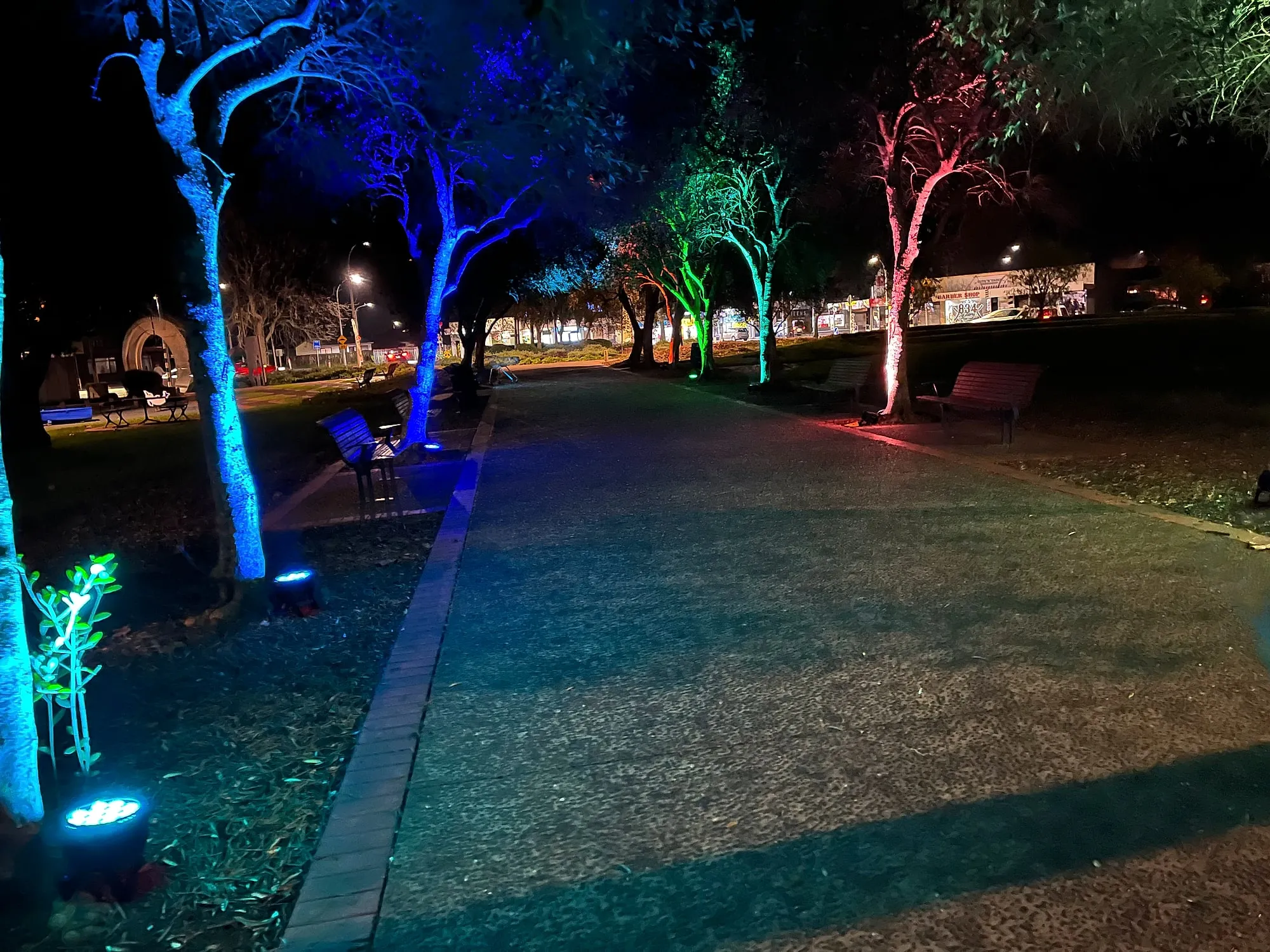
If you take one thing from this guide, take this. Visit the site after dark, at roughly the time your event will be running, and stand in it. Daylight site visits lie to you. A paddock that looks flat and friendly at noon has a different personality at nine in the evening.
Look for four things. First, existing light: streetlights, security floods, light spilling from nearby buildings. It sets what you are working with and what you are working against. Second, the dark corners that matter: the path to the toilets, the car park, steps and level changes. Those need light for safety before anything gets lit for looks. Third, trip hazards, because every one of them is exactly where a cable will want to go. Fourth, where people will actually gather after dark. Guests pool around the bar, the food, the fire and the dance floor, and drift away from big empty lawns. Light where the people will be, not where the site plan says they should be.
Power comes first
Count circuits before you count bulbs. A standard New Zealand power point gives you 10 amps, roughly 2,300 watts, and the circuit behind it is usually shared with every other outlet in the room. Incandescent festoons chew through that fast: a long incandescent run can want a whole domestic circuit to itself, while the same run in LED draws a fraction of it. Then the caterer arrives with urns and ovens, the band brings a PA, and the coffee cart wants its own feed.
A house can usually spare a circuit or two for lighting if the loads are planned. Beyond that, or on a site with no supply at all, proper power distribution or a generator enters the picture. That is normal, not a failure: it is how most installed jobs run. Wherever the power comes from, plan the cable runs early. Cables should go overhead or around the edges of the site, be protected wherever people walk, and always run through an RCD outdoors.
Rigging points and spans
A good anchor is something structural: a building with solid fixing points, a mature tree with a healthy limb, an engineered pole. Spouting, trellis, young trees and marquee frames that were never rated for the load are not anchors, however convenient they look.
Every span sags. That is the look, but it needs allowing for. A long span can drop well over a metre in the middle, so anchor points must be high enough that the low point still clears heads, vehicles and marquee ridges. Festoon cable supports itself over short spans; longer spans want a catenary wire taking the load so the cable and lamp holders are not doing structural work. And a span is a sail. Wind load on a long run of cable and lamps is real, and all of it arrives at the two anchor points, which is another reason the anchors must be structural.
Where a site has no good anchors, poles beat improvisation every time. Properly footed or ballasted poles let you put spans exactly where the design wants them, rather than where the trees happen to be.
Weather and wind
Outdoor fittings carry IP ratings. Translated into practice: kit rated for outdoor use shrugs off rain, and the weak points are the connections, which is why plugs and joins should be sealed and kept up off the ground where water pools. What an IP rating does not cover is wind. Wind is a rigging problem, not a fitting problem.
Plan for the southerly, not the forecast. Auckland weather can turn inside an afternoon, and an installed rig should be built to sit through a blow overnight, because nobody is derigging spans in the dark at two in the morning. That means properly tensioned, structurally anchored, with nothing relying on tape or hope.
The pack-in timeline
Lighting goes up early and comes down last. On a build with a marquee or staging, the lighting crew works around everyone else: spans over a marquee go up after the roof is on, power runs go in before the flooring goes down, and the final focus needs the site clear of ladders, trucks and lifts.
The one scheduling rule that matters most: never plan the switch-on for the hour guests arrive. Lighting can only be judged in the dark, so the rig should be up, powered and checked the evening before, or at worst by the afternoon of the day. A rig that gets its first proper test at dusk on the night is a rig with no time left to fix anything.
If you would rather hand the planning to people who do it every week, ourevent lighting page covers what a designed and installed job includes. Otherwise, start an enquiry with a date, a site and a rough scale, and we will tell you straight what your site needs.